Fiber Art Pattern Sourcing Guide
Build a pattern range customers can understand, complete and return to. This guide covers category planning, product formats, usage rights, class screening, merchandising and evidence-based reordering for rug hooking and wool appliqué retailers.
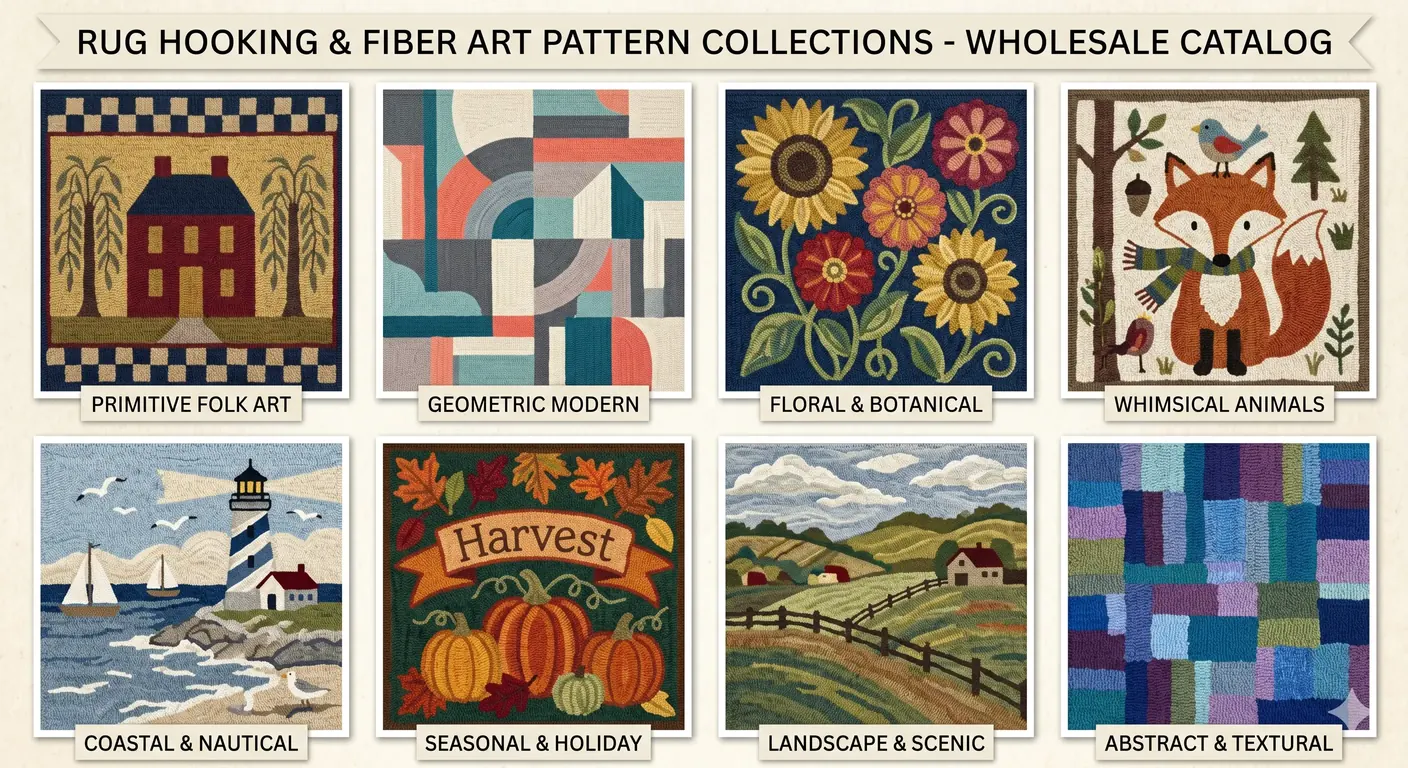
Build the assortment around customer use
Choose patterns as a working range. Cover quick, medium and statement projects; label each by technique, finished use, skill and season. A beginner design needs strong outlines, generous shapes, limited color changes and clear difficult-area instructions—not merely a small footprint. Detailed work needs dependable material estimates and finishing guidance.
Plan across rug hooking and wool appliqué only when the supplier identifies what changes between versions. A paper outline, a pattern drawn on backing and a digital file are not interchangeable products. Before ordering, decide whether each design is meant to sell alone, support a class, anchor a display or become part of a kit. That job should determine the format, quantity and supporting materials you buy.
Bird and nature patterns
Group nature designs as identifiable birds, decorative silhouettes, nests and branches, garden subjects, woodland scenes and seasonal flora. Label a species only when supplier information supports it; customers seeking realism have different expectations from folk-motif buyers.
Check the smallest features at finished scale. Beaks, feet, eyes, narrow stems and leaf gaps may determine the actual difficulty even when the overall project is compact. Favor value guidance—light, medium and dark relationships—over a long list of exact shades. Sky colors, greens, bark neutrals and a few accents can support several designs, while mottled hand-dyed wool may add variation without multiplying single-use colors.
Coastal patterns
Separate nautical subjects such as boats, flags and lighthouses; shore life such as shells, fish and shorebirds; and quieter wave, rope or coastal-geometric designs. Specific labels keep a lighthouse shopper from facing one generic beach category.
Use palette roles rather than one rigid recipe: water, sky, sand, shadow and accent. Sea-glass green, fog gray, rust, faded red and indigo can broaden the category beyond bright blue. If a kit depends on an exact dye lot, establish a substitution plan before ordering depth. In tourist or gift settings, packaging should make the technique, finished size, intended use and included materials understandable to a buyer who may not practice the craft.
Folk and whimsical animal patterns
Separate realistic woodland animals, primitive folk silhouettes and humorous characters. Within each style, a series sharing scale, border, background or format is easier to display and supports related purchases. Useful subgroups include woodland, farm, garden, pets and holidays.
Rate difficulty by expression and detail, not size alone. Tiny eyes, paws, whiskers or ears can carry the character of a piece and may be unsuitable for an introductory class. Strong silhouettes and optional embellishments let students complete the main subject before adding detail. Textured wool can suggest fur or feathers, but the animal still needs a clear value difference from its background. Treat isolated novelty characters cautiously unless they have a specific class, gift or seasonal role.
Floral and geometric patterns
Florals, medallions, checks and repeats stay useful across seasons because palette changes shift their style. Evaluate the offered size: a small-mat motif may become busy on a rug, while narrow petals or repeated corners expose inaccuracies.
For repeats, require repeat dimensions, center lines, registration marks, border instructions and guidance for joining sections. Ask whether resizing is allowed and whether the line weight remains practical after resizing. Color plans should identify value and function—background, main motif, border and accent—so a shop can offer a high-contrast or tonal interpretation without implying that colors are exact requirements. Finishing notes for binding, whipping, fringe or appliqué edges should match the project shown.
Bold-color patterns
Bright color attracts attention, but source the drawing underneath it. Look for a readable focal point, separated shapes, useful negative space and contrast that survives a simpler palette. Ask which small details and specialty fibers are essential and which are optional. That distinction supports a straightforward base kit and an add-on for customers who want more texture or sparkle.
Merchandise a vivid design with its physical material palette, not photography alone, and show a quieter alternative when one is available. Label colors by role so staff can substitute reusable brights instead of accumulating project-specific leftovers. Give bold displays breathing room: a few coordinated designs communicate more clearly than a wall of competing samples.
Seasonal patterns
Work backward from the desired finish date, allowing for delivery, a shop sample, photography, promotion, class time and customer making time. Record final-reorder windows; do not schedule classes around stock that cannot be replenished.
Balance explicit holidays with adaptable seasonal nature, animal and geometric designs. A bird, branch or floral pattern can move from spring to autumn through palette and display changes, reducing the need to replace the whole category. Buy short-lived novelty designs in quantities supported by your own sales, reservations or class plan, and identify an evergreen replacement at a similar size and difficulty before a seasonal design retires.
Require complete format and rights fields
A listing or line sheet should answer these questions. Put permissions in writing; one purchased copy does not normally grant reproduction, teaching or resale rights.
| Field | What to confirm |
|---|---|
| Identity | Designer or publisher, exact title, stable SKU, version and technique. |
| Finished object | Width and height, intended use, orientation and finishing method. |
| Difficulty | Required skills, recommended cut or stitch approach and the details that make the rating appropriate. |
| Materials | Backing or foundation, wool quantities, value plan, thread, notions, tools and realistic substitutions. |
| Format | Paper or digital; full-size or tiled; drawn-backing fiber, grain and margin; file type, page size and printing scale; exactly what a kit includes. |
| Rights | Personal use, class copies, student purchases, kit assembly, resizing, finished-item sales and use of supplier photography. |
| Wholesale status | Cost, minimums, lead time, reorder terms, stock code and notice or final-order policy for retirement. |
For digital files, also confirm download limits, update access and whether the retailer may deliver files to customers. Do not forward a master file or print student copies unless the license explicitly permits it. For drawn backing, specify whether instructions and a color key are included rather than assuming the backing is a complete project package.
Run sample and class-use checks
Before using a sample
- Compare the full design, close details and stated dimensions; a photograph alone cannot show line clarity at working scale.
- Confirm which technique, size and materials the pictured sample represents.
- Review quantity assumptions, substitutions, backing margins and finishing directions before planning a large kit run.
- Label a display with its pattern SKU, format and palette so staff can sell the correct version.
- Describe a project as shop-tested only if the shop actually made and documented it.
Before scheduling a class
- Obtain written terms for instructor copies, one copy per student, handouts, kits and class promotion images.
- Match the design’s small details and required skills to the session length and stated student level.
- Confirm enough legal copies and materials can arrive before enrollment opens.
- Choose a section students can reasonably complete in class, with optional details for faster makers.
- Keep the permission record with the class plan rather than relying on a verbal understanding.
Merchandise complete, comparable projects
Organize by subject family, then expose size, skill, technique and format. Place a finished sample or authorized image beside the pattern, palette card and relevant tools. Show inclusions, separate purchases and finishing supplies so customers can assess the complete project cost.
Build bundles around color roles and materials usable across designs. An alternate colorway shows flexibility but should not obscure supplier quantities or shop substitutions. Keep SKUs on samples and class displays, and group related series so any staff member can fulfill requests.
Reorder from shop records, not assumptions
Track each SKU by subject, style, format and role, noting whether it sold alone, with wool, through a class or as a gift. Record unfulfilled requests, common substitutions and designs requiring staff explanation. This shows whether to reorder the pattern, its palette, both or neither without a universal benchmark.
Maintain supplier lead times, minimums, release schedules and discontinuation notices in the same record. Reorder dependable series while all components remain available; use smaller commitments for unproven novelty or short seasonal windows. If a pattern supports a recurring class, reserve legal pattern copies and replace it before stock ends. A substitute should match technique, difficulty, project size and material needs—not merely the theme.
Continue supplier research
Use the supplier directory to compare pattern designers and supporting fiber-art vendors, then document format, rights and reorder terms consistently.